

Functional Food & Beverage Trends 2026
AIFI has identified several functional ingredient & processing trends shaping food and beverage manufacturing in 2026, building on our Food & Beverage Trends report from earlier this year. Functional foods and beverages are products formulated to deliver a health benefit beyond standard nutrition. In 2026, no other ingredient category is driving that shift more than functional proteins.
Vantage Market Research values the global functional food ingredients market at roughly $118.4 billion in 2025, projected to reach $206.7 billion by 2035. The broader functional food market is estimated at $383.2 billion in 2026, climbing toward $634.19 billion by 2034. Protein leads that growth, remaining the single largest driver of demand within functional ingredients, and more than 60% of food manufacturers report an increased focus on clean label, fortified, and personalized nutrition products built around it.
What Are Functional Proteins?
Functional proteins are protein ingredients selected and processed to do more than add grams to a nutrition label. They’re chosen for amino acid completeness, digestibility, solubility, and performance in concentrated, minimally processed formats. These proteins are used in ready-to-drink (RTD) shakes, snack bars, and other products. Whey protein isolate is the benchmark ingredient in this category. It delivers a complete amino acid profile, mixes cleanly with minimal off-flavor, and performs well in heat-treated beverages when formulated properly, making it a go-to choice for manufacturers formulating protein-dense products at scale.
Trend to Watch: The GLP-1 Effect on Protein Demand
One of the biggest forces accelerating protein fortification is the rapid rise of GLP-1 medications. Industry estimates suggest roughly one in five U.S. households now includes someone using these drugs, and users report meaningfully lower calorie intake, smaller appetites, and a shift away from processed snacks and sugar toward protein and produce.
Because these consumers eat less, muscle preservation depends on making every gram of protein count, and manufacturers need complete, highly digestible protein sources that perform well in the smaller, more concentrated formats this audience favors.
AIFI Functional Protein Ingredients
American International Foods, Inc. sources and distributes a full range of functional protein ingredients for manufacturers & processors formulating RTD shakes, protein-fortified snacks, and dairy alternatives. Below are some selected protein ingredients offered by AIFI:
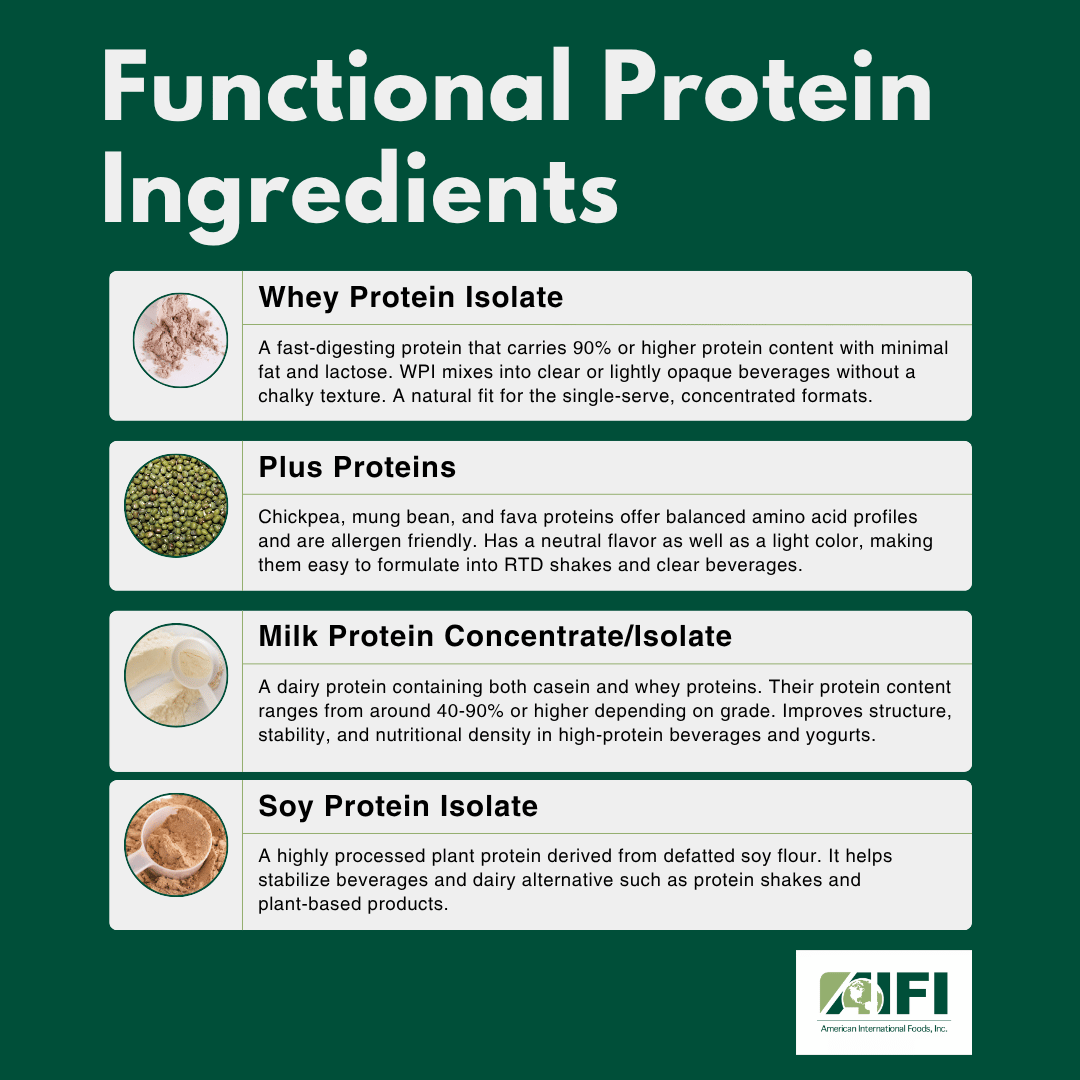
Whey Protein Isolate
A complete, fast-digesting protein that carries 90% or higher protein content with minimal fat and lactose. WPI mixes into clear or lightly cloudy beverages without a chalky texture and is a natural fit for the single-serve, concentrated formats GLP-1 consumers favor.
Pulse Proteins
Chickpea, mung bean, and fava proteins offer balanced amino acid profiles and allergen-friendly, plant-based positioning. Their neutral flavor and light color make them easy to work into low-volume, concentrated formats like RTD shakes & clear beverages.
Milk Protein Concentrate & Milk Protein Isolate
A dairy protein containing both casein and whey proteins, with protein content ranging from roughly 40% up to 90% or higher depending on grade. It improves structure, stability, and nutritional density in high-protein beverages and yogurts, making it a useful complement to whey protein isolate in fortified formulas.
Soy Protein Isolate
A highly processed, complete plant protein derived from defatted soy flour. Its strong emulsifying properties help stabilize beverages and dairy alternatives, and it’s widely used across protein shakes, plant-based products, and fortified snacks.
Fiber & Gut Health: Supporting Protein-Forward Formulas
Protein isn’t the only functional ingredient under pressure to perform in smaller servings. Digestive comfort is one of the biggest formulation considerations alongside protein fortification, since slowed gastric emptying and appetite suppression frequently come with nausea, bloating, and constipation. The type of fiber a manufacturer pairs with protein matters as much as the amount.
Prebiotic Fibers (Inulin)
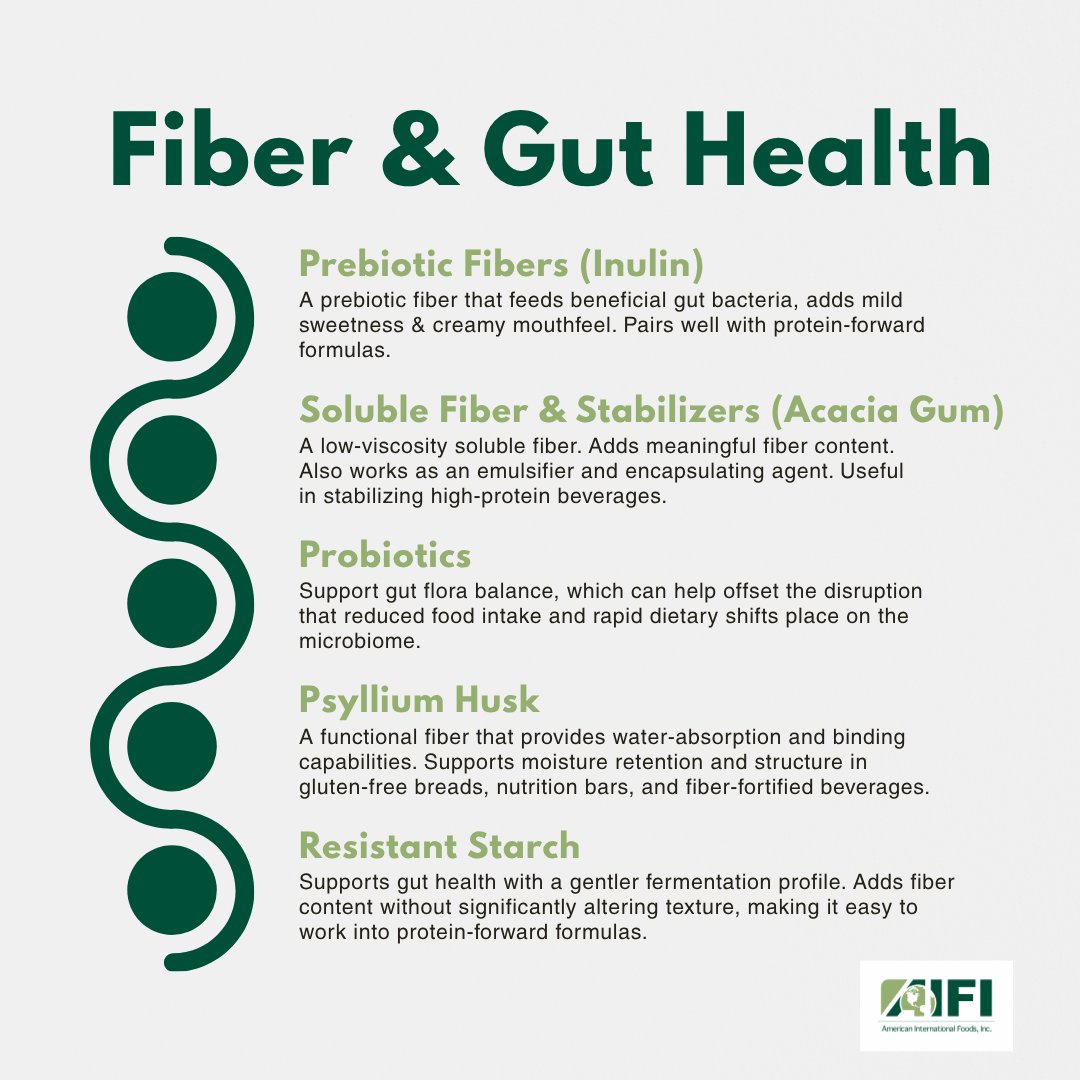
Inulin, sourced from chicory root and Jerusalem artichoke, is a well-studied prebiotic fiber that feeds beneficial gut bacteria and adds mild sweetness and creamy mouthfeel. It pairs well with protein-forward formulas, though its fermentation rate can cause gas and bloating in more sensitive consumers, so formulators should consider moderating dose or pairing it with slower-fermenting fibers.
Soluble Fiber & Stabilizers (Acacia Gum)
Acacia gum is a largely non-fermentable, low-viscosity soluble fiber. It adds meaningful fiber content without the gas and bloating that faster-fermenting fibers can cause, and it also works as an emulsifier and encapsulating agent, useful in stabilizing high-protein beverages.
Probiotics
Probiotics, such as live Lactobacillus and Bifidobacterium strains, support gut flora balance, which can help offset the disruption that reduced food intake and rapid dietary shifts place on the microbiome. Encapsulated or freeze-dried strains with guaranteed CFU counts at expiration hold up best alongside protein processing.
Psyllium Husk
Psyllium husk is a functional fiber valued for its water-absorbing and binding properties. It supports moisture retention and structure in gluten-free breads, nutrition bars, and fiber-fortified beverages, making it a useful complement to protein in more concentrated formats.
Resistant Starch
Resistant starches are starches that resist digestion in the small intestine and ferment more slowly in the colon than many other fibers, supporting gut health with a gentler fermentation profile. They add fiber content without significantly altering texture, making them easy to work into protein-forward formulas.
Processing & Stabilization for Concentrated, Protein-Dense Formats

Because consumers are eating less overall, every product needs to deliver more protein and nutrition per bite or per ounce, which puts pressure on processing and stabilization technology. Protein, probiotics, vitamins, and other bioactives are sensitive to heat, moisture, shear, and pH, all of which are unavoidable in commercial processing. Encapsulation has become an essential tool for protecting ingredient integrity in these more concentrated formats. The global food encapsulation market is projected to reach $9.8 billion in 2026 and grow to nearly $19.7 billion by 2036.
Gums & Hydrocolloids
Support emulsification, viscosity control, and suspension of protein and other functional ingredients in concentrated, high-shear formulations.
Acidulants & pH Adjusters
Help maintain the pH range needed to maintain protein solubility and probiotic cultures stable during and after processing.
Starches
Serve as carrier and wall materials for encapsulation while supporting texture in fortified, protein-dense products.
Antioxidants & Preservation Aids
Protect flavor, color, and nutrient stability across shelf life, which matters more as products pack more protein and functional payload into a smaller serving.
Clean Labels
Smaller pack sizes and higher protein density don’t give manufacturers a pass on ingredient transparency. Protein-focused consumers tend to be highly engaged label-readers, and several major food companies have moved toward shorter ingredient lists alongside their protein-forward reformulations. The clean label ingredient market is projected to reach $212.4 billion by 2030, and upcycled byproducts, such as fruit peels and vegetable pulp repurposed for fiber and antioxidants, are gaining ground as manufacturers look to add functional value without adding complexity to the label.
Protein-Forward Formulation
High-protein RTD beverages are a useful blueprint for the kind of product driving growth in 2026: low in calories, meaningfully fortified with a complete protein source, and gentle on digestion. Leading products in the category build around whey protein isolate, or a blended whey and plant protein system, to hit 20 to 30 grams of protein per serving while keeping the ingredient list short and recognizable.
That approach, building the formula around one high-quality protein source and layering complementary fiber and stabilization ingredients around it rather than maxing out several competing claims, illustrates the formulation strategy manufacturers should be applying more broadly: lead with protein quality, manage mouthfeel and digestive tolerance, and keep the label clean.
What Manufacturers Should Focus On
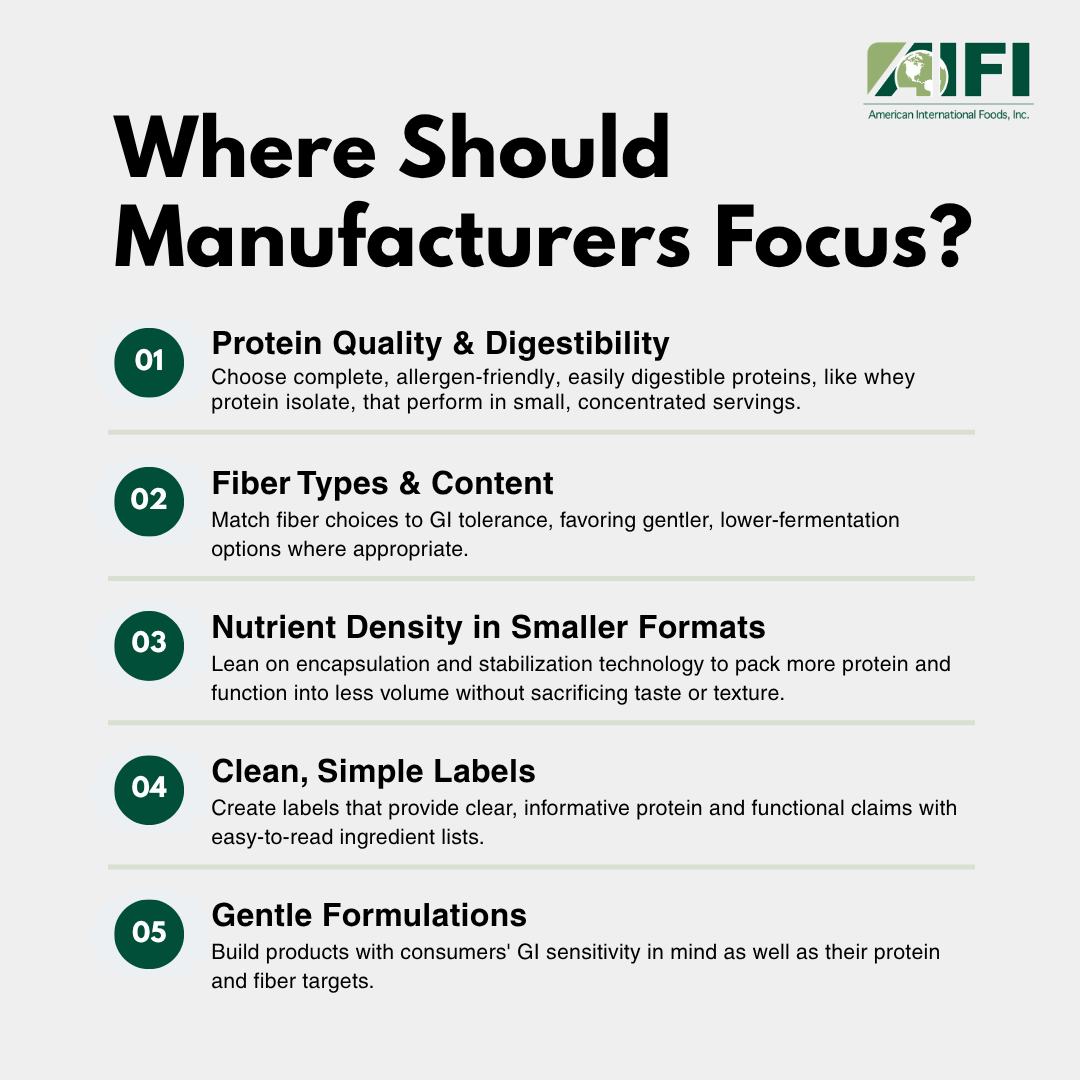
Protein quality & digestibility
Choose complete, allergen-friendly, easily digestible proteins, like whey protein isolate, that perform in small, concentrated servings.
Fiber type, not just fiber content
Match fiber choice to GI tolerance, favoring gentler, lower-fermentation options where appropriate.
Nutrient density in smaller formats
Lean on encapsulation and stabilization technology to pack more protein and function into less volume without sacrificing taste or texture.
Clean/Simple Labels
Pair protein and functional claims with ingredient lists consumers can read and trust.
Gentle formulation
Build products with consumers’ GI sensitivity in mind, not just their protein and fiber targets.
As GLP-1 adoption continues to climb through 2026 and beyond, functional food and beverage manufacturing is moving past isolated protein additions toward fully integrated formulation strategies built around high-quality functional protein. Manufacturers that treat protein quality, fiber tolerance, nutrient density, and clean labeling as parts of one connected system, rather than separate marketing claims, will be best positioned to serve today’s consumer at scale.
About AIFI – A Leading Food & Beverage Ingredient Supplier & Distributor

We recognize the importance of staying ahead of consumer trends. American International Foods, Inc. has over 20 years of experience in helping its clients effectively predict and respond to top ingredient trends in the food manufacturing sector. We strive to offer our clients several ingredient options, including non-GMO, gluten-free, organic, and fair trade.
We maintain complete documentation for each ingredient we offer, allowing our customers transparency and peace of mind. AIFI provides its customers with unparalleled industry knowledge, personalized supply chain solutions, and a complete product line comprised of more than 2500 food and beverage ingredients.
For further information about ingredient sourcing, pricing, general inquiries, or additional information regarding functional foods & ingredients, please contact AIFI using the link below.