

There’s a good reason why protein, clean label, and plant-based positioning are still the trends getting the most headlines. They’re what consumers respond to on shelf.
The hard part for food and beverage manufacturers often shows up after they commit to food ingredient trends. That’s roughly the same time when headaches start around sourcing strategies, spec sheets, and lead times.
We’ve identified four developments from our 2026 Food & Beverage Trend Predictions outlook that stand out because they’re the operational reality behind the headline trends. As we head into the summer, here’s what we’re seeing and hearing in the market.
1. Protein Sourcing Is Becoming a Major Portfolio Decision
 A year ago, the protein ingredient conversation was mostly about which new source to add. Now it’s about how many sources a formulator needs to keep on hand at once.
That’s because instead of asking how much protein a product contains, formulators need to know the protein systems that can effectively balance nutrition, taste, texture, and cost.
Brands that are running multiple SKUs are increasingly building out a full roster of proteins rather than standardizing on only one. A bar line might lean on pea protein isolate for cost, for example, while a beverage line might go with milk protein concentrate for solubility and a bakery line uses wheat gluten for structure. Rather than picking a single winning protein, manufacturers are managing a portfolio, which is what committing to the protein trend at scale seems to require.
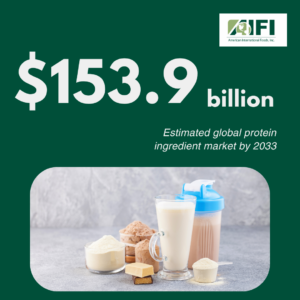
According to Coherent Market Insights, the global protein ingredients market is sized at roughly $99 billion in 2026 and is expected to grow toward $153.9 billion by 2033, with food and beverage applications accounting for nearly 67% of that demand. Suppliers are already building toward this multi-source reality at the formulation level: Roquette, a French plant-based ingredient producer, launched four separate pea protein formats (isolated, hydrolysate, and textured), each engineered to perform differently across plant-based dairy, meat alternatives, and beverage applications.
Dairy proteins remain in high demand, but interest is also growing around alternatives like pea, fava bean, wheat protein isolate, and TVP.
According to Cargill’s April 2026 research, 61% of consumers said they increased their protein intake in 2024, citing taste, health benefits, and nutritional value as the reasons why.
Why does this matter? Single-source dependency is becoming a liability. Buyers who are locked into one protein supplier are finding it harder to flex pricing or volume when that source tightens, and that is pushing more conversations toward diversified sourcing relationships rather than single-vendor contracts. The next challenge is not adding protein. It’s making protein work across more applications.
2. Ingredient Specs Are Getting More Demanding
It’s tempting to assume the ingredient list on a label is getting longer to chase more claims. In practice, the opposite pressure is showing up at the formulation level: fewer ingredients, and each needs to be doing more.
Many food and beverage ingredient categories are becoming more multifunctional. Proteins, fibers, starches, and fermentation-derived ingredients are now expected to contribute to nutrition, texture, stability, and processing performance all at the same time. This shift is particularly visible in plant-based and hybrid formulations, where every ingredient is being asked to do more work.
As reported by Innova Market Insights’ 2026 trend outlook, complexity is becoming a liability for brands as consumer trust in elaborate ingredient lists wanes, with naturalness reshaping formulation across colors, flavors, and protein sources.
Formulators also expect a starch that used to handle viscosity alone to hold up through retort processing and contribute to a cleaner label declaration. A fiber added for a digestive-health claim has to clear sensory testing too, not just a nutrition panel.
These are the tradeoffs that come with the clean label trend once it moves from the label copy to the formulation sheet.
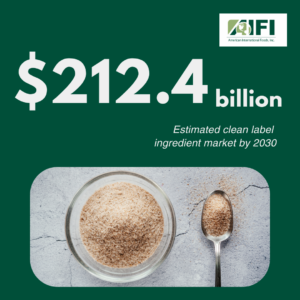
As reported in our previous article, AIFI’s 2026 Food & Beverage Trends, the clean label ingredient market is projected to reach $212.4 billion by 2030.
Why does this matter? Formulation decisions are becoming interconnected. Changes made for nutrition often affect texture, shelf life, and more. Therefore, suppliers are fielding more technical questions earlier in the formulation process, not after a prototype fails.
3. Mainstream Menus Are Setting the Pace for Global Flavors
 Flavor trends used to start in specialty grocery stores and slowly trickle up to national brands over a couple of years. That lag is shrinking.
Ingredients inspired by Korean, Southeast Asian, Middle Eastern, and Latin American cooking are showing up in mainstream retail and foodservice locations on a much faster timeline than in past cycles. Global flavors can be regularly found in all kinds of mainstream snacks, sauces, beverages, and prepared foods.
According to Datassential, 88% of U.S. consumers now live near a globally influenced restaurant and 78% have access to a global grocer or ethnic market, with 55% of those consumers saying they often choose global foods over other dining options.
Restaurant chains and quick-service menus are often the first to commit to an ingredient at volume, which puts pressure on the supply chain well before a packaged product hits the shelves. This is what global flavor adoption and demand requires of a supply chain once it moves at restaurant speed vs. grocery speed.
As reported by Tastewise, which tracks 115 million menu items across roughly 873,000 U.S. restaurants, Southeast Asian flavor claims are up 41% and Thai applications are up 44% in the poultry category alone over the past year, with bao bun formats up 188%.
What once might have been considered novel is now considered normal.
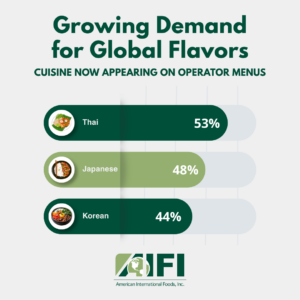
According to flavor house Mother Murphy’s, Thai cuisine now appears on 53% of operator menus, Japanese on 48%, and Korean on 44%, with Filipino the fastest-growing segment.
Why does this matter? The lead times for sourcing decisions have been compressed. The demand for specialty ingredients is going to make consistency, availability, and supply chain resilience increasingly important. A flavor profile that gets traction can create ingredient demand spikes faster than buyers were previously used to, and that in turn makes early supplier relationships and inventory positioning more valuable than they used to be.
4. Texture Is Getting Its Own Line Item in Development Budgets
 Nutrition claims can get a product onto a shelf. Mouthfeel is increasingly the factor that decides whether or not it stays there.
Whether it’s the creaminess of a beverage, the crunch of a snack, or the bite of a protein-rich bakery item, texture is a key differentiator in many crowded categories. Many of the most important ingredient innovations today are focused on improving sensory performance without sacrificing nutrition or processing efficiency.
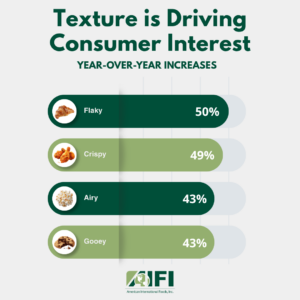
As reported by Tastewise, analysis published in early 2026 tracking consumer interest in specific textures found sharp year-over-year increases across the board: flaky up 50%, crispy up 49%, airy up 43%, and gooey up 43%, with smooth, crunchy, soft, chewy, and sticky descriptors also trending upward. Products that stack multiple textures at once, like mochi delivering soft, chewy, and sticky in a single bite, are often the ones overperforming.
Formulation teams are allocating dedicated testing time and budget specifically to sensory performance that’s separate from nutrition and shelf-stability testing. That’s a shift from adjusting the texture after formulators first lock in a nutrition profile. Instead, food and beverage manufacturers are treating texture and mouthfeel as their own development workstreams from day one. That is part of the cost of competing on a food ingredient trend that’s no longer optional.
Why does this matter? Taste obviously still matters, but texture is poised to become an important driver of future innovation. That means ingredient selection will start earlier in the development timeline rather than later. Suppliers who can bring sensory data alongside nutritional data should have an easier time getting into early-stage formulation conversations.
What Food Ingredient Trends are Next in 2026?
Food and beverage development isn’t going to get any easier anytime soon. Sourcing teams want flexibility, formulators want ingredients that multitask, and timelines keep getting shorter.
These four shifts show what it takes to act on the food ingredient trends everyone’s already talking about, and how a dedicated supply chain partner can make all the difference.
One big question heading into the back half of 2026: Are your sourcing and formulation strategies built to act on the ingredient trends you’re already committed to? If not, maybe we should talk.

AIFI: A Leading Food & Beverage Ingredient Supplier & Distributor
For more than 20 years, American International Foods, Inc. has helped manufacturers effectively predict and respond to top ingredient trends in the food and beverage industry. We offer our clients more than 2,500 ingredient options, including non-GMO, gluten-free, organic, and fair trade.
We maintain complete documentation for each ingredient we offer, giving you the transparency and peace of mind to meet tight deadlines and foster innovation.
For more information about ingredient sourcing, pricing, or additional information, fill out our contact form or call (866) 944-2434 to speak with one of our sourcing specialists.