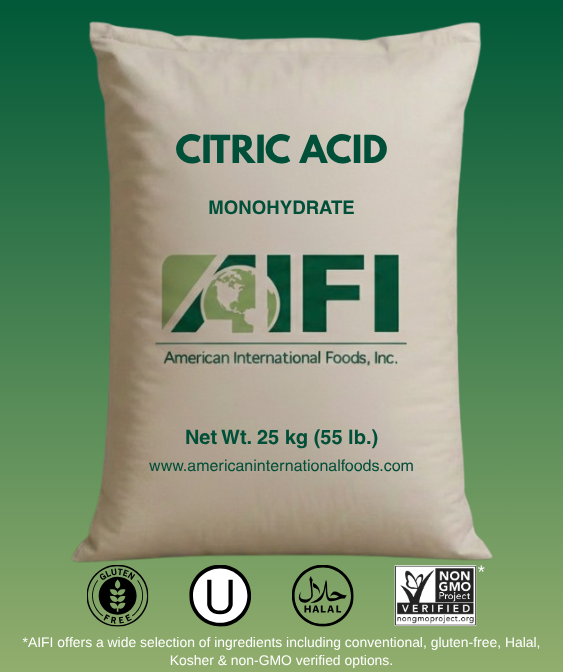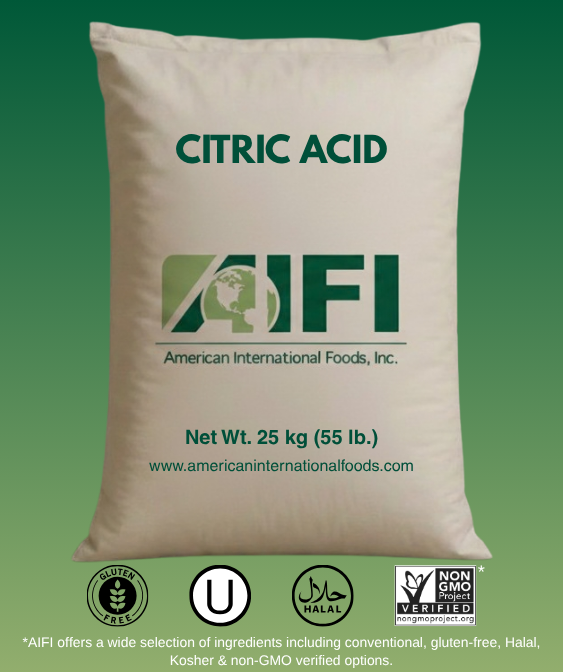
Citric Acid

What is Citric Acid?

Citric acid is a naturally occurring organic acid found abundantly in citrus fruits such as lemons, limes, oranges, and grapefruits. As one of the most widely used acidulants in food and beverage manufacturing, it delivers a clean, bright sour taste and serves multiple functional roles across a broad range of product categories including:

  • pH Adjustment & Acidification: Lowers and stabilizes pH in beverages, jams, jellies, canned goods, and dairy products, supporting both safety and desired flavor profiles.
  • Flavor Enhancement & Sourness: Imparts a clean, refreshing tartness in soft drinks, powdered beverages, candies, and confections, and amplifies existing fruit & citrus flavor notes.
  • Preservation & Antimicrobial Support: Inhibits microbial growth by lowering water activity and pH, extending shelf life in sauces, dressings, and processed foods.
  • Antioxidant & Color Retention: Chelates metal ions (particularly iron and copper) that catalyze oxidation, helping to protect flavor, color, and nutritional quality in fruit & vegetable products and processed foods.
  • Emulsification & Texture: Functions as a sequestrant in dairy processing (e.g., processed cheese, cream cheese) to improve texture, meltability, and consistency.
  • Leavening System Component: Used in conjunction with baking soda in bakery applications to provide controlled CO₂ release and support desired crumb structure.
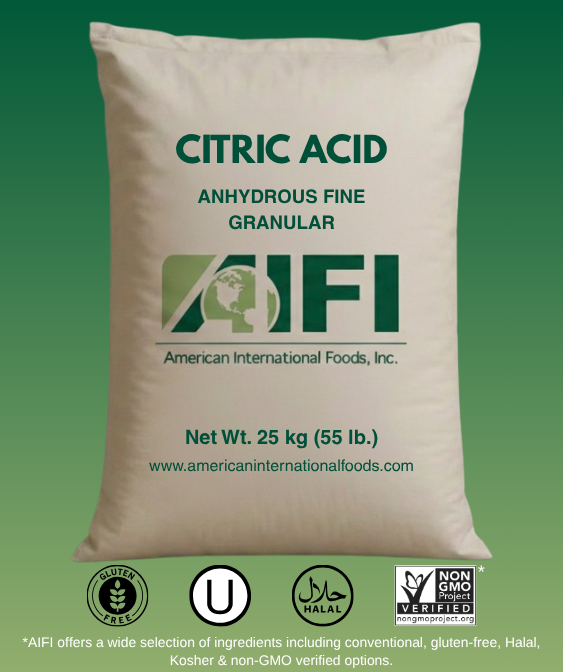
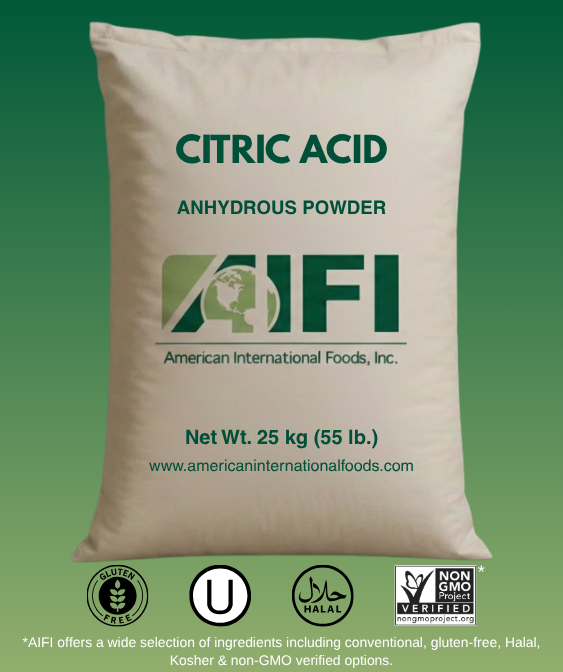
← Return to Ingredient Categories

Questions about Citric Acid Availability, Pricing or Product Specs?

Click Here to Contact a Sales Representative

AIFI's Ingredient Certifications


Citric Acid Technical & Product Specifications

Characteristic

Specification

Chemical Name/Synonyms Citric Acid (2-hydroxypropane-1,2,3-tricarboxylic acid; E330)
CAS Number 77-92-9 (Anhydrous)  |  5949-29-1 (Monohydrate)
Molecular Formula/Weight C₆H₈O₇ / 192.12 g/mol (Anhydrous)  |  C₆H₈O₇·H₂O / 210.14 g/mol (Monohydrate)
Appearance White crystalline powder or colorless crystals
Taste Strong, clean sour / acidic taste
Solubility Freely soluble in water (~147 g/100 mL at 20°C); soluble in ethanol; slightly soluble in ether
pH (1% aqueous solution) ~2.2 (conforms to typical food-grade behavior; concentration-dependent)
pKa Values pKa₁ = 3.13, pKa₂ = 4.76, pKa₃ = 6.40
Density/Bulk Density ~1.665 g/cm³ (crystal); bulk density ~800–900 kg/m³ (granular)
Melting Point ~153°C (Anhydrous); ~135°C (Monohydrate, decomposes with water loss)
Flash Point Not applicable (non-flammable solid)
Hygroscopicity Anhydrous form is moderately hygroscopic; Monohydrate is more stable under humid conditions
Certifications/Grades FCC and USP food-grade with Kosher status available
Packaging Options 55lb / 25kg bags; bulk supersacks available upon request
Typical Assay (Purity) ≥99.5% on anhydrous basis (FCC / USP standard)
Microbial Limits Conforms to FDA / USP food safety standards
Heavy Metals Conforms to FCC limits (≤10 ppm as Pb)
Water Content Anhydrous: ≤0.5%; Monohydrate: 8.0–9.0% (FCC)

Regulatory & Handling Considerations

  • FDA / GRAS Status (USA): Citric acid is affirmed as GRAS under 21 CFR §182.1033 and is authorized for general use in food.
  • EU Authorization (E330): Approved as food additive E330 under Regulation (EC) No 1333/2008
  • FCC / USP Compliance: Food-grade citric acid must meet the Food Chemicals Codex (FCC) or USP monograph standards for assay, heavy metals, microbial limits, and water content.
  • Hygroscopicity & Storage: Anhydrous citric acid is moderately hygroscopic and should be stored in cool, dry, well-ventilated conditions in tightly sealed containers. Monohydrate is generally more stable under humid conditions. Avoid prolonged exposure to high humidity to prevent caking.
  • Temperature Sensitivity: Citric acid solutions are generally stable during typical processing temperatures. At elevated temperatures (>175°C), dehydration and decomposition can occur. Formulation adjustments may be required in high-heat applications.
  • Ingredient Interactions: Acts as a synergist with other antioxidants (e.g., ascorbic acid, tocopherols) by chelating pro-oxidant metals. Compatible with most food ingredients; care should be taken in highly alkaline systems where it may react with carbonates and bicarbonates.
  • Labeling: Must be declared on ingredient labels as “Citric Acid” in the U.S. (per 21 CFR Part 101). EU products must list as “citric acid” or “E330.”

Benefits of Citric Acid for Food & Beverage Manufacturers

  • Provides clean, bright sourness and enhances flavor across a wide range of product categories
  • Effectively lowers and stabilizes pH to inhibit microbial growth and extend shelf life
  • Chelates pro-oxidant metals, protecting flavor, color, and nutritional quality
  • Versatile across anhydrous and monohydrate forms to suit specific processing requirements
  • Functions synergistically with other antioxidants and preservatives for optimized formulations
  • Meets global food-grade standards (FDA GRAS, EU E330, FCC, USP) for safety and purity
  • Widely available in bulk with consistent supply through AIFI’s nationwide distribution network

About American International Foods, Inc. (AIFI) - An Citric Acid Supplier & Distributor

American International Foods, Inc. is a leading citric acid supplier with an additional full-service portfolio of over 2500 food and beverage ingredients. We offer one of the most extensive lines of acidulants distributed to manufacturers and processors in the food, beverage, pet food, health and nutrition sectors. With a strategic nationwide warehouse network and our reliable just-in-time deliveries, we can supply your business with high quality citric acid at competitive prices.